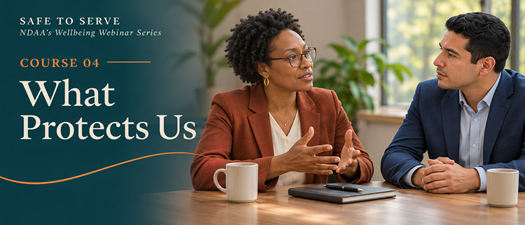
Wellbeing Series: Safe to Serve | Course 4: What Protects Us
Join Us Virtually
What Protects Us
March 25, 2027 | 2:00-3:30 p.m. Eastern
(Free for Members!)
OverviewA resource may be available without being usable. Time away requires coverage. Protected preparation time can disappear under repeated interruptions. An offer of support may have little effect if people lack the authority, relationships, or working conditions needed to use it. What Protects Us helps participants determine what would meaningfully support someone under the actual demands of prosecutorial work. Using evidence about human performance and developing prosecution scenarios, participants consider recovery, connection, belonging, agency, psychological safety, and organizational resources. They weigh imperfect options, identify barriers, and decide who can make a proposed support possible. The course then asks how to determine whether the change helped. What You Will Do in This Program
|
Potential CLE CategoriesWellbeing or wellness competence; professional development. Categories vary by jurisdiction. Approval and credit hours are not confirmed; these potential categories do not establish course eligibility. |
CostMembers: Free! Please note that this course has been approved for individual attendees only. If you intend to broadcast this to a group, please contact us at training@ndaajustice.org. |
Eligibility:NDAA is committed to serving prosecutors and the professionals who support the prosecution function. Attendance is limited to prosecutors, investigators, victim advocates, witness coordinators, paralegals in local, state, tribal, federal, and military government attorneys' offices, law enforcement professionals, and other members of the multidisciplinary team who work in or closely with prosecution. If you are not sure about your eligibility, please contact ssencer@ndaajustice.org |
General Questions?
Please contact training@ndaajustice.org.
| Credits | Price | |
|---|---|---|
|
Member Ticket
Registration Opens 11/9/26 at 12:00 AM EDT
|
1.25 | FREE |
| Credits | Price | |
|---|---|---|
|
Non-Member Ticket
Registration Opens 11/9/26 at 12:00 AM EDT
|
1.25 | $75.00 |
Anticipated Continuing Legal Education Credits 1.25 hour
NDAA will apply for CLE credit in Illinois, Kansas, Mississippi, Missouri, Ohio, Pennsylvania, Tennessee, Texas, and Virginia based on state requirements and guidelines. All other attorneys seeking CLE credit should contact their state bar for more information. At the conclusion of the course and after completion of the electronic evaluation survey, all attendees will receive a uniform continuing education certificate that they may use to report their continuing education hours to their state bar or reporting agency. Questions regarding CLE can be directed to cle@ndaajustice.org
For More Information:
Part of the Safe to Serve SeriesBeyond the Courthouse is the third of six connected courses and can be taken individually. It brings the series’ emphasis on sound judgment and shared responsibility into personal and professional safety. Designed For Practicing prosecutors, supervisors, and office leaders looking for support that fits the work and can be put into practice. |
|
Key Topics Include
|
|
Take Home Resources
|